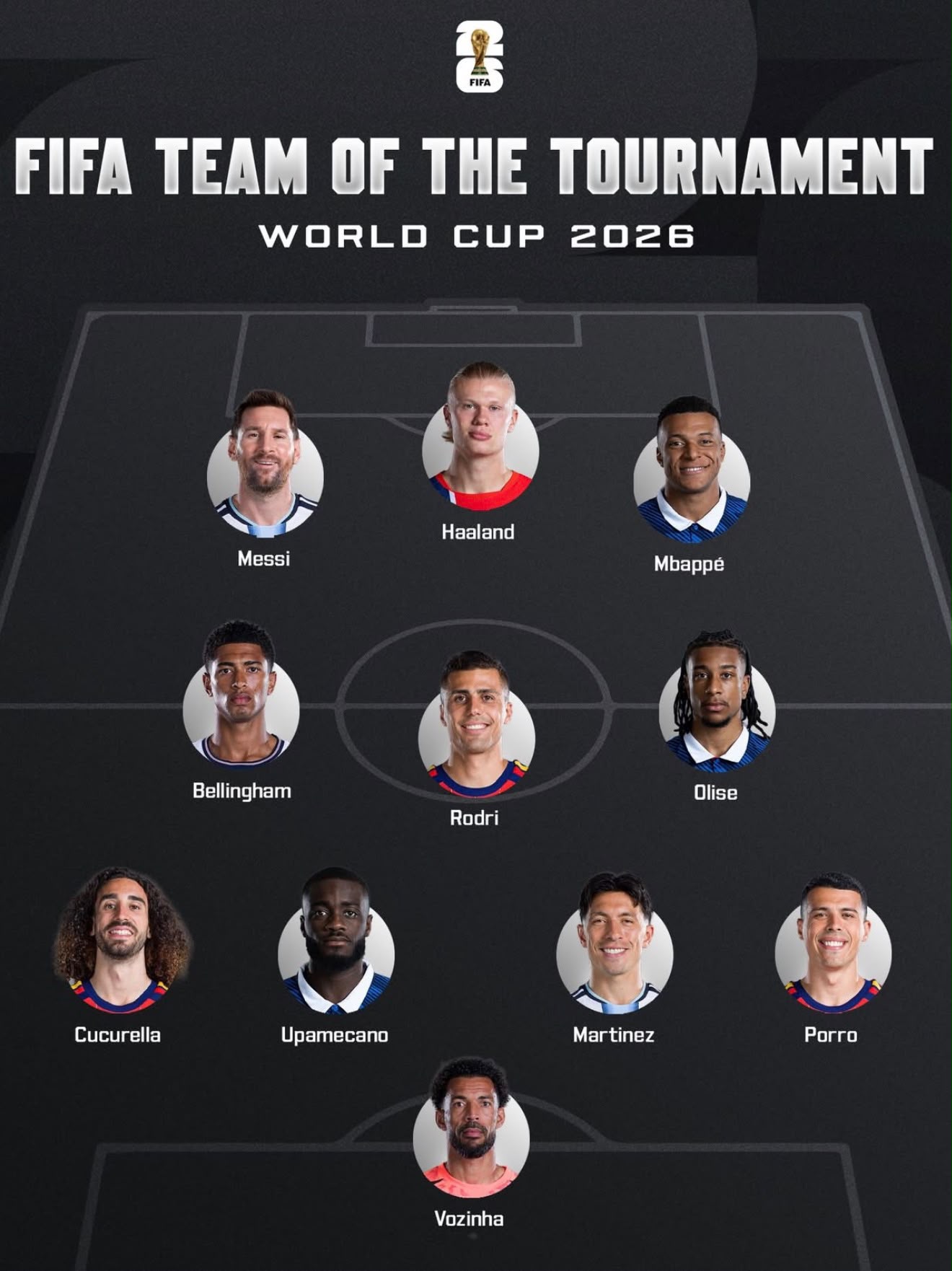
World Cup 2026 Team of the Tournament: Why Each Player Deserved a Place
Overview
The standout XI of the 2026 World Cup brought together players who had a decisive impact for their national teams. The selection was not based on reputation alone, but on crucial saves, defensive consistency, creativity and goals that changed matches.
Vozinha: the goalkeeper who surprised everyone
Cape Verde goalkeeper Vozinha was one of the tournament’s biggest revelations. He produced exceptional performances relative to his team’s history and resources, making difficult saves that gave his teammates confidence and kept Cape Verde alive in several matches.
The comparison with Spain’s goalkeeper, who conceded only once during the tournament, was compelling. Spain’s keeper offered consistency behind a powerful defence, while Vozinha faced a heavier volume of dangerous chances. For many observers, that individual influence justified his place in the XI.
Marc Cucurella: the complete full-back
Cucurella was among the best left-backs both defensively and offensively. He strengthened Spain’s back line, closed spaces on the left and still advanced regularly to deliver dangerous passes and crosses. His ability to combine pressing, possession and attacking support made him essential to Spain’s system.
Dayot Upamecano: France’s defensive power
Upamecano excelled in aerial and ground duels and handled powerful forwards with his pace and strength. His contribution went beyond defending: he carried the ball out and helped launch quick attacks from the back, especially in major matches where France needed both security and progression.
Lisandro Martínez: consistency and fighting spirit
Martínez was one of Argentina’s most consistent defenders on the road to the final. He stood out for his aggression, reading of the game and bravery in challenges, while his passing quality supported Argentina’s build-up from the back. His personality brought calm and balance in difficult moments.
Pedro Porro: Spain’s weapon on the right
Porro provided tremendous energy in both directions. He supported attacks, created chances from the right and moved constantly to open spaces without neglecting his defensive duties. He became one of Spain’s key outlets when the team needed width and deliveries into the box.
Jude Bellingham: England’s midfield leader
The Real Madrid midfielder was decisive, powerful and influential. Bellingham scored important goals, created numerous chances and led England’s midfield through his physical presence and movement between the lines. He was also among the leading contenders for the Golden Boot.
His team-first mentality was clear when he handed a penalty to Bukayo Saka against France, helping his teammate complete a hat-trick. It was a moment that captured Bellingham’s character: collective success before personal numbers.
Rodri: the brain of Spain
Rodri was the balancing force in Spain’s midfield. He controlled the tempo, linked defence and attack and offered solutions under pressure through accurate passing and intelligent positioning. His work was not always the most spectacular, but it was fundamental to Spain’s control and stability.
Michael Olise: the tournament’s leading creator
Olise enjoyed a remarkable campaign for France, recording seven assists and becoming their main creative threat both centrally and from wide areas. His dribbling, final pass and ability to switch play made him extremely difficult to contain.
His performances also intensified transfer speculation linking him with Real Madrid. Whatever happens next, the tournament established him among the elite players in his position.
Lionel Messi: the legend defies age
At 39, Messi delivered another exceptional tournament. He scored eight goals, provided four assists and led Argentina to the final, repeatedly stepping forward whenever his team faced elimination or a difficult situation.
His influence extended beyond goals through his composure, creativity and control of decisive moments. That made his place in the strongest XI fully deserved.
Erling Haaland: the Viking who led Norway
Haaland scored seven goals in five matches, contributed to chance creation and drove Norway through a historic campaign. His display against Brazil was one of the tournament’s defining moments and proved that he could decide matches against the strongest opposition.
His movement in the box, power, speed and finishing made him the natural choice at centre-forward.
Kylian Mbappé: the tournament’s leading star
Mbappé was the most complete and influential player of the competition. He led his country to the title, won the Golden Boot and remained a constant threat through his speed, technique and finishing in major matches.
He also continued to break World Cup records while still young enough to achieve much more. Mbappé is not merely a scorer; he creates, leads attacks and can transform a match in a single moment.
Conclusion
This XI combines a goalkeeper who changed games with his saves, defenders who blended strength with build-up quality, midfielders who controlled the rhythm and an attacking trio that delivered goals and leadership. Opinions may differ in some positions, but the impact of these players made their inclusion logical and deserved.